

Description
Warning: mysqli_query(): (HY000/1194): Table 'wp_options' is marked as crashed and should be repaired in /www/wwwroot/excelcrane.com/wp-includes/class-wpdb.php on line 2349
Warning: mysqli_query(): (HY000/1194): Table 'wp_options' is marked as crashed and should be repaired in /www/wwwroot/excelcrane.com/wp-includes/class-wpdb.php on line 2349
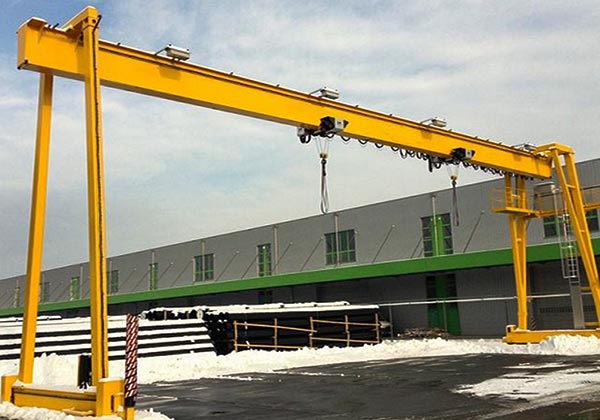
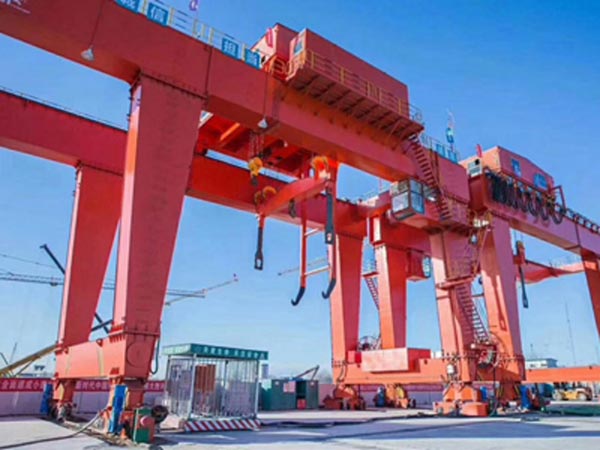
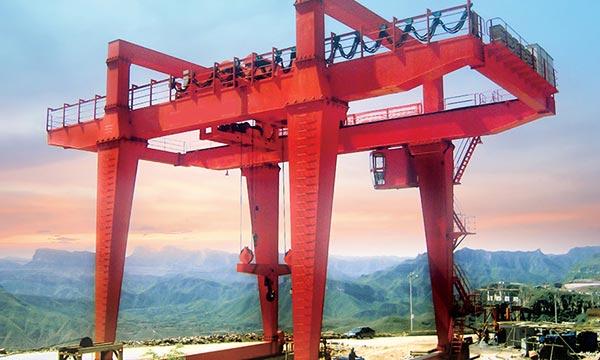
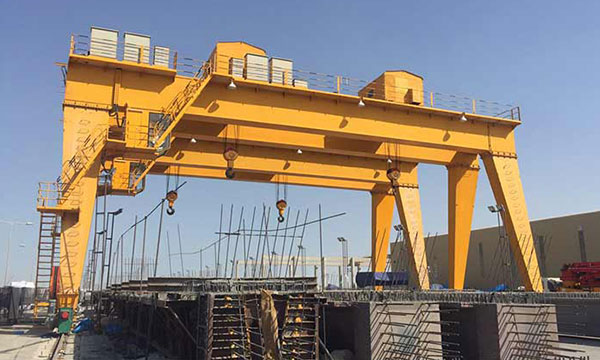
The rolling double-girder gantry crane is a heavy-duty mechanical equipment used for large-scale material handling and loading and unloading operations. It is widely used in industrial and mining enterprises, open-air warehouses, and railway lines. It adopts a double main beam structure, has high lifting capacity and large span, and can efficiently complete various heavy object handling tasks. The following is a detailed analysis of the rolling double-girder gantry crane:
1. Technical parameters:The lifting capacity is generally between 10t and 160t, which is suitable for large-scale heavy objects transportation.he lifting height is usually between 12 meters and 30 meters, and can be adjusted according to the use environment.The span range is from 18 meters to 40 meters, suitable for large-scale operations.Casting steel overhead cranes are made from high-quality cast steel, which provides exceptional strength and durability. They have a long service life and are highly resistant to wear and tear.
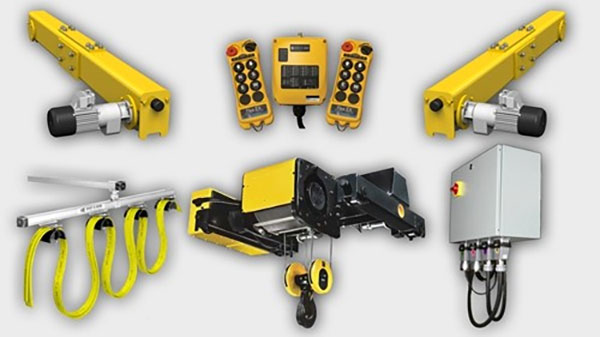
2. The control mode can be operated on the ground or through wired or wireless remote control, which is flexible and convenient. It can also be operated from the cab, with closed and rear or side door-opening operating rooms for different environments.
3. It conducts electricity through cables, has good flexibility, and is suitable for changeable operating environments. It also conducts electricity through sliding conductors and is suitable for places with fixed areas and frequent operations.
4. In terms of safety maintenance, equipment needs to be inspected and maintained regularly to ensure that it is in good working condition. In addition, the user must conduct regular self-inspections of the crane to discover and solve potential problems in a timely manner.

Components of rolling gantry crane
1. Main girder
- The main girder of the rolling double-girder gantry crane adopts a box-shaped or truss structure and is welded from section steel. It has high strength and stability to withstand large lifting loads.
- The main girder of rolling double-girder gantry crane generally uses high-strength steel in material selection to ensure that it can withstand larger loads and dead weight. This design form not only improves the stability of the overall structure, but also enhances the durability and safety of the crane.
- The main beam and the end beam are connected by bolts or welding to form a rigid structure to ensure overall stability. This connection method not only facilitates transportation and installation, but also improves the reliability and maintenance convenience of the crane.

2. Lifting System
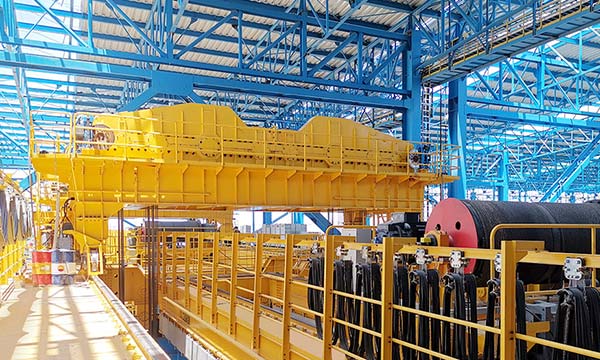
The lifting system of the rolling double-girder gantry crane is composed of a motor, reducer, brake, drum, etc., and the hook or other spreader is raised or lowered through a wire rope or chain to achieve vertical movement of the material. The following is a detailed analysis of the lifting system of the rolling double-girder gantry crane:
- Electric motor: When the power of the lifting motor reaches more than 26 kilowatts, a stator voltage and speed regulation system is usually selected to ensure smooth operation. The thyristor commutation method is used to realize stator voltage and speed regulation, avoiding the problem of contactor damage in traditional speed regulation systems and improving system reliability.
- Reducer: The reducer needs to have a high transmission ratio to provide enough torque to lift heavy objects. Usually made of cast steel or cast iron, it has good strength and wear resistance and can adapt to complex working conditions.
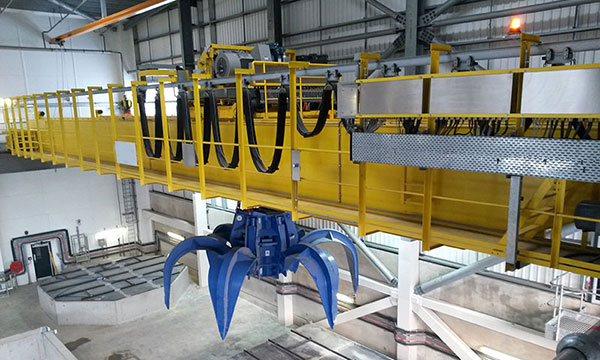
- Hooks and spreaders: According to different material characteristics, you can choose a variety of spreaders such as hooks, grab buckets, and electromagnetic chucks. Hooks and other hoisting tools have been strictly tested and have a high safety factor to ensure that they will not break during the hoisting process.
3. End Carriages
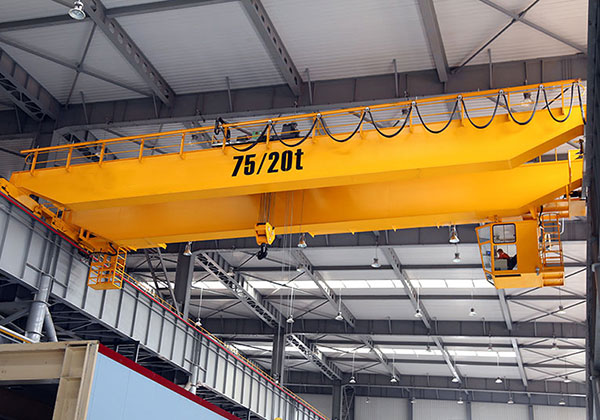
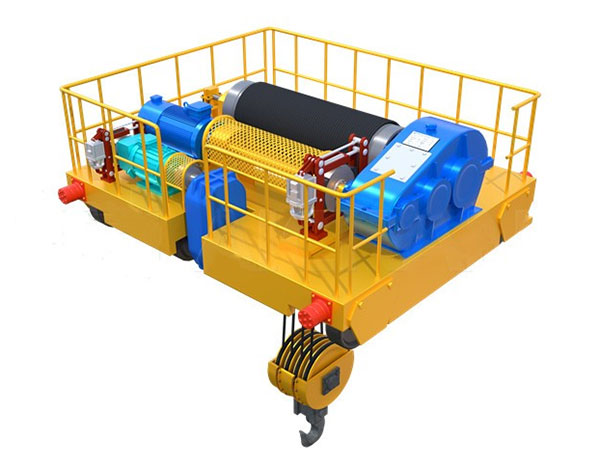
- The end girder of a double girder overhead travelling crane is the key structure connecting the two main girders, which plays an important role in maintaining the rigidity and stability of the bridge frame, and at the same time supports the travelling mechanism of the big vehicle to move on the track.
- The end girder mainly consists of a torsion-resistant box-shaped profile and a full set of travelling devices (including gear motor and travelling wheels). This design accommodates a wide range of load capacities and fulfils special application requirements for safe lifting and mechanical travelling movements.
- The design of the end beam not only takes into account the travelling characteristics and load requirements, but also focuses on ease of assembly and ease of maintenance. It is usually made of high-strength steel to ensure that it can withstand high loads and deadweight.
4. Crane traveling mechanism
The operating mechanism of double girder overhead travelling crane is reasonably designed, and each mechanism works in coordination to ensure the high efficiency and safety of the crane. The composition and working principle of each mechanism will be described in detail below:
- Crane wheels:The wheel of the crane is an important part that connects the crane with the ground or the track, and its main role is to support the crane’s self-weight and load, and to ensure that it can move smoothly during the working process.
- Gearbox: The main role of the gearbox of the crane is to change the transmission ratio, adjust the operating speed and torque of the crane to ensure its efficient operation in various working conditions.
- Brake system:The crane’s braking system ensures efficient and safe operation and prevents accidents during operation.Control system: This system helps to operate the crane traveling mechanism and to control the crane’s movement, speed, and direction.
- Electrical system: The power supply system of the crane is responsible for the introduction of electrical energy from the external power grid, and reasonably distributed to the crane’s various electrical components through the distribution box. The power supply system also has a perfect protection function, in the event of electrical failure can quickly cut off the power supply, to protect the safety of operators and equipment.
In summary, a robust and efficient crane traveling mechanism is essential for a casting steel overhead crane to transport heavy loads smoothly and safely.
5. Trolley traversing mechanism
Small and medium-sized cranes usually use centralised drive form of the trolley running mechanism, that is, the motor through a transmission system to drive all wheels. The trolley running mechanism of large cranes mostly adopts the form of separate drive, and each wheel has an independent motor and reducer.
The trolley running mechanism must be installed with a brake to stop safely after power failure, and be checked and adjusted every 2-3 days. Install terminal travel limiters at both ends of the trolley’s travel to ensure that the trolley can collide with the limiter’s rotating arm when it reaches the terminal and open the contacts to stop after power failure.
The trolley running mechanism of the crane is the device responsible for moving horizontally on the main beam of the crane, and it realises the adjustment and handling of the articles in the transverse position by driving the wheel set through the electric motor. The crane’s trolley running mechanism is reasonably designed, and the components work together to ensure the high efficiency and safety of the crane.
The trolley running mechanisms of cranes play a vital role in transporting goods horizontally and adjusting the working position. Through rational design and standardised technical requirements, these mechanisms ensure the efficient and safe operation of cranes under various working conditions.
6. Crane wheel
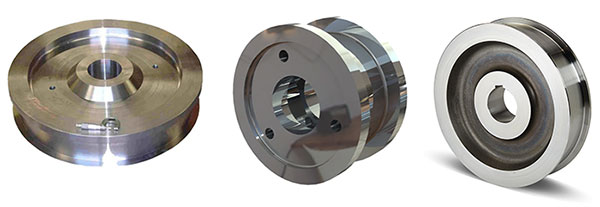
The design and materials of the wheels need to comply with international standards and industry norms to ensure their performance and safety under high-intensity working conditions. Crane wheels can be divided into double rim wheels, single rim wheels and rimless wheels according to the form of rim. The main role of the rim is to guide and prevent the car body from derailment, to ensure the stable operation of the crane on the track. Double rim wheels are usually used for large vehicles, height of 25 ~ 30 mm; single rim wheels are mostly used for small vehicles, height of 20 ~ 25 mm; rimless wheels need to be used with the level of the guide wheel to prevent derailment.
7. Crane hook
Crane hook spreader is a device directly used for lifting items, usually used in conjunction with the pulley block, according to different lifting capacity and work requirements, divided into two types of single hook and double hook. The following is a detailed introduction to the crane hook spreader:
- Hook type: Single hook is usually used for smaller lifting capacity due to its relative ease of manufacture and use. Its structure is simple, easy to maintain, suitable for some light or small and medium-sized cranes. Double hook is more reasonable force, lighter weight, suitable for larger lifting capacity. The design of double hook can distribute the load more evenly, reduce the pressure on a single point, and improve the safety and efficiency of lifting operation.
- Precision manufacturing: The manufacture of hooks requires precision casting, forging and welding processes, and each hook undergoes rigorous quality inspection before it is put into use. Welds require special treatment to ensure that they are free of cracks and defects.
- Safety inspection: Before use, a thorough safety inspection of the hook must be carried out, including an external inspection of the hook, internal flaw detection and load testing. Once any cracks or other damages are found, it should be stopped immediately.
- Regular maintenance: Hooks require regular maintenance, including cleaning, lubrication and anti-corrosion treatments to prevent rust and wear. Frequency of inspection and maintenance should be increased for hooks that are used frequently.

8. Motor
- Providing the main power: When the electric motor is used as the main engine of the crane, it turns out the torque to drive other systems or components of the crane, playing the role of starting the crane. This role is critical in all types of cranes.
- Direct drive spreader: The electric motor can directly drive the spreader of the crane to provide power support for lifting and transporting, so that the operation can be completed efficiently and smoothly. For example, bridge crane motors generally use AC induction motors, which are inexpensive and easy to maintain.
- The electric motor of the crane plays a vital role in driving the crane for various operations. Its selection, calibration and maintenance directly affect the performance and safety of the crane.

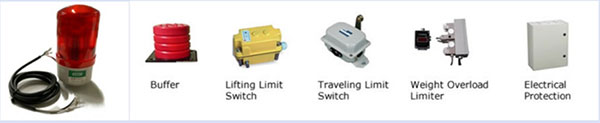
9. Sound and light alarm system & limit switch
- Crane audible and visual alarm systems and limit switches are an important part of crane safety protection devices used to provide warnings and prevent accidents during crane operation.
- Acousto-optic alarms are mainly used for warning and prevention in crane operations. When the crane appears abnormal or dangerous situation, the sound and light alarm will emit strong sound and light signals to remind the operator to take timely measures.
- Limit switches are used to control the hoisting mechanism of a crane to work within a certain set height range and prevent it from exceeding the safety limits. Limit switches are also used in the crane’s trolley running mechanism and trolley running mechanism, when the crane runs to the limit position of the track, the limit switch will cut off the corresponding control power supply, so that the mechanism stops running, so as to protect the crane from being damaged.
- Crane audible and visual alarm systems and limit switches play a vital role in ensuring the safety of crane operations. They effectively reduce the probability of operational errors and accidents by providing immediate warning and strict limit control.
10. Safety Devices
There are several safety devices that can be installed on casting steel overhead cranes to prevent accidents and injuries. These devices include:
- Lifting height limiter: It is used to limit the rising height of the hook or fetching device, and can immediately cut off the lifting power source when it reaches the upper limit position specified in the design. This device can prevent the hook from over-reeling and avoid major accidents.
- Running travel limiter: installed in each running direction, when the crane or trolley runs to the limit position of the track, it can automatically cut off the power source in the forward direction. This prevents the crane or trolley from running out of the track and causing danger.
- Lifting capacity limiter: When the actual lifting capacity exceeds the set value, the device will issue an alarm signal and automatically cut off the hoisting power source when the overload reaches a certain percentage. This can effectively prevent crane overturning or other safety accidents caused by overloading.
- Lifting Torque Limiter: Used to control the lifting torque of the crane, the same will alarm and cut off the power source when the torque exceeds the rated value. This is particularly important for tower cranes, whose rated lifting capacity varies with amplitude.
- Anti-tipping safety devices: such as levelling devices, outrigger retraction locking devices, etc., to ensure that the crane remains stable during operation and prevent tipping accidents caused by uneven ground or improper operation.
- Buffers and end stops: Buffers and stops are installed at the end of the rail to prevent the crane from derailing and at the same time reduce the impact on the equipment.
11. Control Mode
The control mode of the crane is the core of its operation and operation, which determines the working performance and safety performance of the crane. With the continuous progress of technology, the crane control mode is also from the traditional manual control to automation, intelligence, remote control and other directions. The following is a detailed introduction to the main control mode of the crane:
- Operation room control: the operator in the crane operation room through the buttons, switches, etc. to control the action of each mechanism. This way is simple and intuitive, but the operator is more labour-intensive, and requires high operating skills.
- Wireless remote control: using radio waves to transmit control signals to achieve remote operation of the crane. This type of control is more flexible, can significantly improve operational efficiency and safety, especially for large-scale work sites.
- PLC control: Programmable Logic Controller (PLC) technology is widely used in crane control systems. Through preset procedures, PLC can achieve precise control of complex crane movements, and has fault diagnosis and automatic recovery functions. For example, in the hoisting mechanism speed control, trolley and trolley operation control, PLC technology plays an important role.
- Safety monitoring and protection system: The safety control mode of the crane includes scientific control of the moving direction, all-round monitoring, automatic fault detection and treatment. Through multiple sensors and actuators, it ensures that the crane operation is carried out within a safe range, which greatly reduces the operation risk.
Crane control mode from the traditional manual control gradually developed into automation, intelligence and remote control, not only enhance the operational efficiency and operational accuracy, but also significantly enhance the safety and stability of equipment operation.
12. Sketch

Application of rolling gantry crane
Double girder gantry cranes are widely used in engineering technology and various fields, and are important equipment for mechanised and automated production. This kind of crane is widely used in different workplaces such as factories, warehouses, yards and so on due to its stable structure, superior performance and convenient operation. The following is a detailed introduction to the application of double girder gantry cranes:
- Industrial production and manufacturing: In industrial production lines, raw materials usually need to be moved from one handling process to another. Double girder gantry cranes can easily realise this kind of long-distance and large-volume material handling through their high load-bearing capacity and moving mechanism along the beams. This not only improves the efficiency of material transport, but also reduces the loss of materials during transit.
- Engineering and construction sites: During construction, many components need to be placed accurately, such as steel nodes and large curtain walls. Double girder gantry cranes can achieve millimetre-level precision positioning through advanced control systems, ensuring that construction materials are accurately and precisely placed at the intended location. This greatly facilitates subsequent construction and ensures project quality and progress.
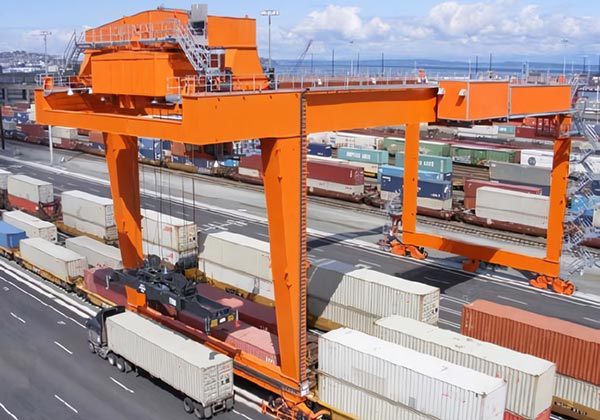
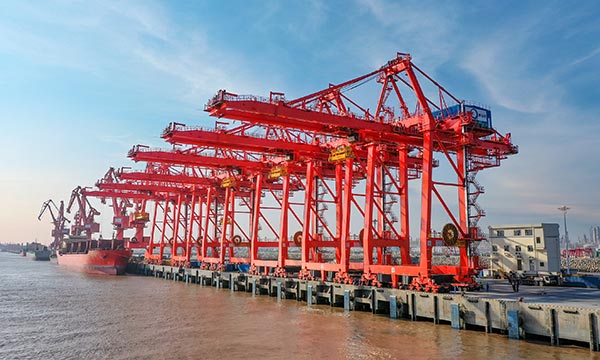
- Ports and terminals: In ports and terminals, double girder gantry cranes are used for handling and stacking containers, enabling fast and efficient cargo handling and increasing port throughput.
- Special environmental applications: In some high-temperature or hazardous environments, such as metallurgy and chemical industry, double girder gantry cranes are designed to adapt to these special environments to ensure the normal operation of the equipment and the safety of personnel.

Advantages of rolling gantry crane
Below are some advantages of casting steel overhead crane:
- Honeycomb girder design: Double girder overhead travelling crane with honeycomb girder design features light weight, large load and strong wind resistance. The honeycomb girder structure ensures the strength of the equipment while significantly reducing the deadweight, enabling the crane to operate stably even when carrying heavy loads.
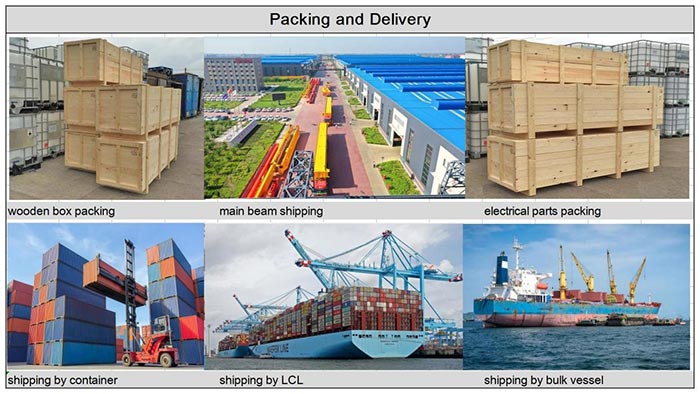
- Easy to transport: The flexible rod legs and site steering can be disassembled into individual parts for easy transport. This design greatly reduces transport difficulties and costs, allowing the equipment to be quickly transferred between sites.
- Efficient Handling: Equipped with intelligent control system, it can realise efficient cargo handling and precise positioning, and improve operation efficiency.
- Remote control: Support remote control, can be operated by button or remote control in the control room, reduce the labour intensity of the operator, and improve safety.
- Multi-field application: Rolling double girder overhead travelling crane is widely used in industrial and mining enterprises, iron and steel chemical industry, railway transport, port terminal and logistics turnover and other departments and places, and has become an indispensable and important equipment in these industries.

Main technical data

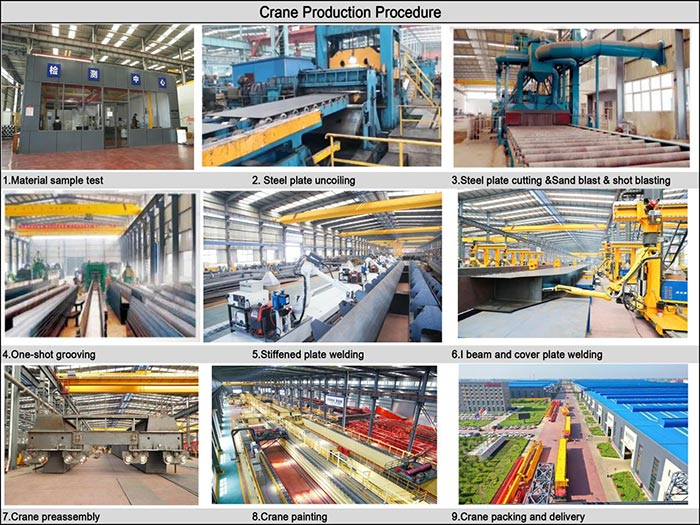
Crane production procedure
The production process of double girder gantry cranes is complex and delicate, involving multiple processes and technical requirements, and each step is crucial from design to final assembly. This type of crane is widely used in engineering and construction sites, etc. due to its high load carrying capacity and stability. The following is a detailed introduction to the production process of double girder gantry cranes:
- Design phase: The design phase is the most important and basic step in the whole production process. The design team needs to determine the structural form, main girder type and various technical parameters of the crane according to its working requirements and usage environment. Usually, the design of double girder gantry cranes takes into account their high load carrying capacity, large span and complex working environment.
- Assembly and welding: assembly and welding are the key links in building the main structure of the crane. Firstly, the cut steel plates and steel sections are assembled according to the design drawings to ensure that the position of each part is accurate. Then, through advanced welding technology, these parts are welded together. The welding quality is directly related to the safety and service life of the crane.
- Weld testing: After welding is completed, the weld needs to be tested for strict quality. Commonly used detection methods include ray detection, ultrasonic detection and so on. These testing methods can ensure that there are no cracks, porosity and other defects inside the weld, thus ensuring the robustness and safety of the structure.
- Integral welding moulding: As the most important load-bearing part of the crane, the manufacturing process of the main girder is particularly critical. Usually the whole welding forming method is used, the cover plate and the web plate are put together first, and then the internal rigid fixed structural parts are welded.
- Component assembly: after all the main components are manufactured, the whole machine needs to be assembled on the assembly platform. In this process, it is necessary to assemble the main beam, end beam, trolley, trolley running mechanism and other components together in strict accordance with the design drawings and assembly process requirements. The position and connection of each component need to be accurately in place to ensure the firmness of the whole machine structure and smooth operation.
- Load test: After assembly and commissioning, the crane needs to be load tested. This test is usually divided into static load test and dynamic load test to check the performance of the crane in the actual work. The testing process needs to simulate the actual working conditions, a comprehensive inspection of the crane to ensure that its performance indicators in line with the design requirements.
- Factory acceptance: After passing the load test, the crane is ready for final factory acceptance. This link is mainly by the quality inspection personnel on the appearance of the crane, performance, random documents and other comprehensive inspection. After the acceptance, the crane can be packed and ready to be delivered to the customer.
Global Market
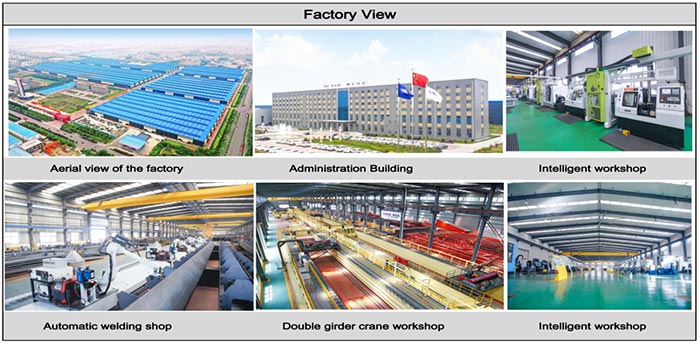
Workshop view
The company has installed an intelligent equipment management platform, and has installed 310 sets (sets) of handling and welding robots. After the completion of the plan, there will be more than 500 sets (sets), and the equipment networking rate will reach 95%. 32 welding lines have been put into use, 50 are planned to be installed, and the automation rate of the entire product line has reached.