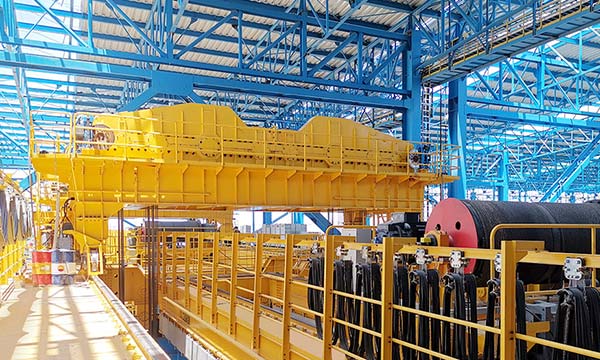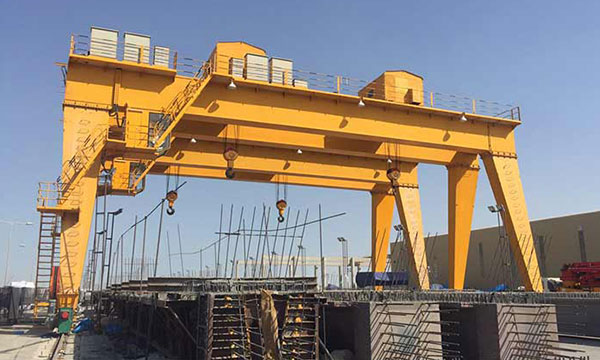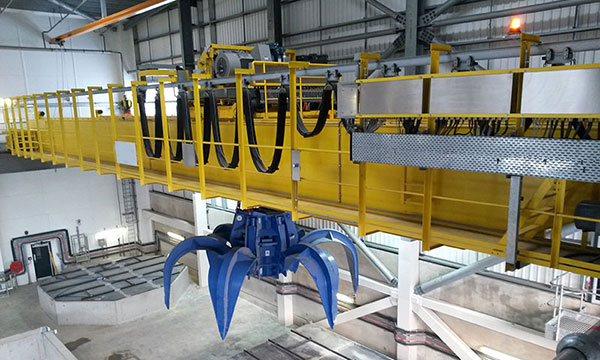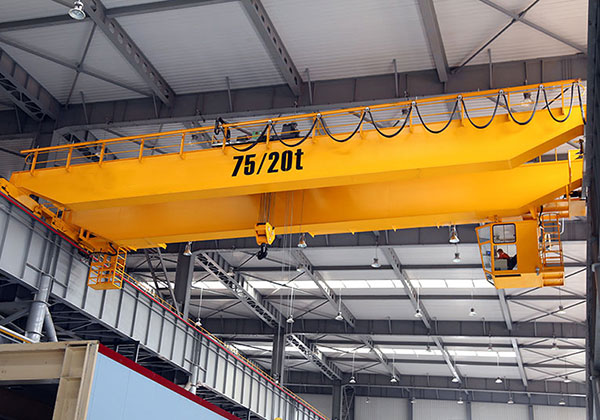


Description
Warning: mysqli_query(): (HY000/1194): Table 'wp_options' is marked as crashed and should be repaired in /www/wwwroot/excelcrane.com/wp-includes/class-wpdb.php on line 2349
Warning: mysqli_query(): (HY000/1194): Table 'wp_options' is marked as crashed and should be repaired in /www/wwwroot/excelcrane.com/wp-includes/class-wpdb.php on line 2349
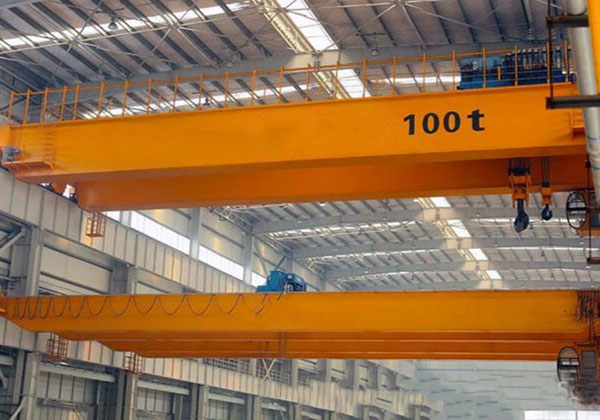
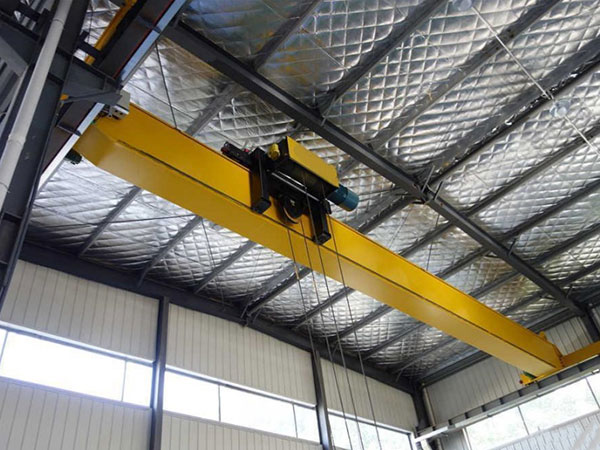
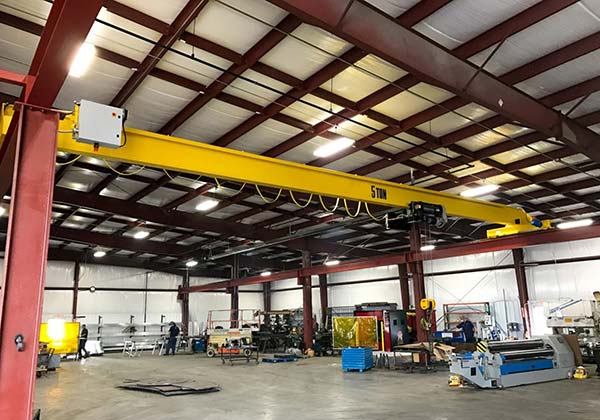
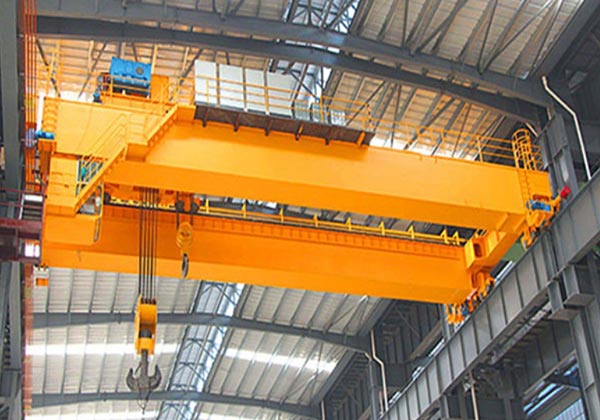
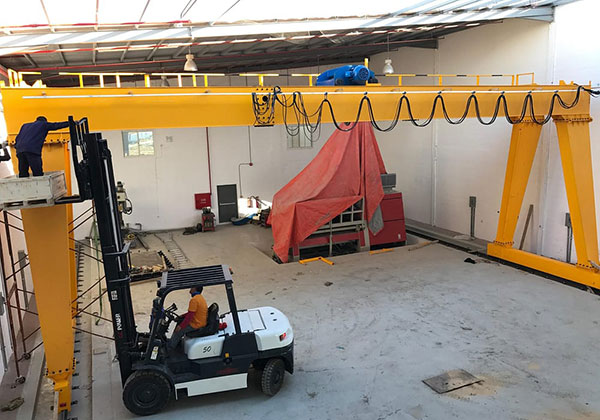
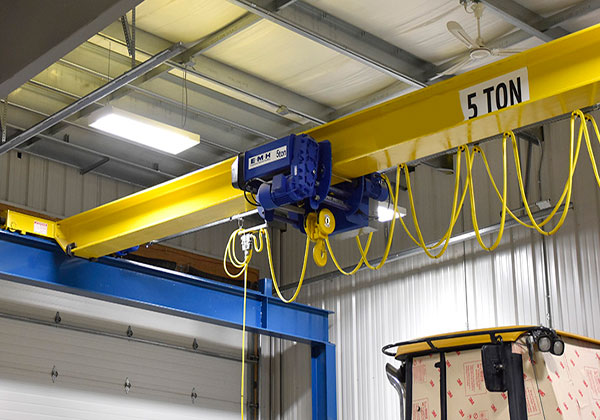
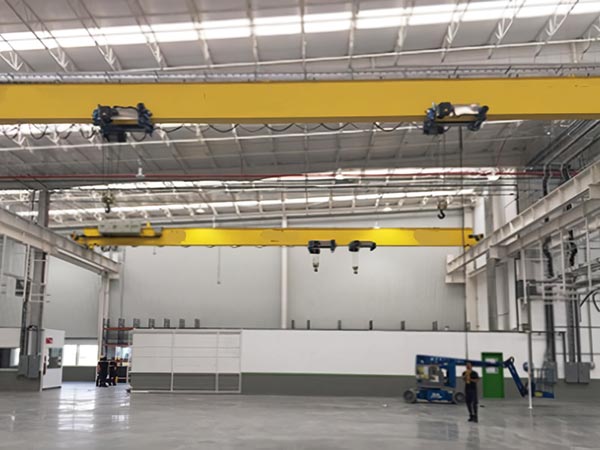
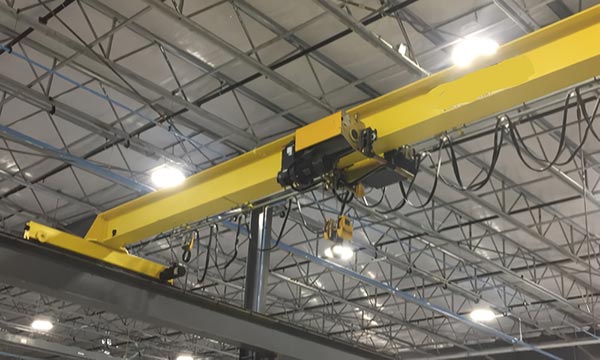
Bridge girder cranes are usually composed of a single main beam, end beam, lifting mechanism, operating mechanism and electronic control system. The main beam usually adopts a box structure or I-beam structure, which has high strength and rigidity. The running track of the crane is generally laid on the steel structure beam of the factory building or on the wall support frame.
Single-beam bridge cranes can be operated manually or electrically. Electric operation is usually equipped with a wireless remote control or ground control button, making operation more convenient and safe. The carrying capacity of single-beam bridge cranes is usually between 1 ton and 20 tons, which can be customized according to customer needs. The lifting height and span can also be adjusted according to the requirements of the actual work site.
Single-beam bridge cranes are widely used in manufacturing, warehousing and logistics, construction sites, electric power, chemical industry, shipbuilding and other industries, especially suitable for small and medium-sized factories or environments with limited space. In order to ensure safe operation, single-beam bridge cranes are usually equipped with a variety of safety measures such as overload protection devices, limit switches, emergency stop devices, anti-collision devices, etc.
Single-beam bridge crane is a kind of lifting equipment widely used in various industrial sites, usually used for material handling, loading and unloading and stacking operations. It has the advantages of simple structure, easy installation and flexible operation. Single-beam bridge crane has become one of the commonly used lifting solutions in various industrial sites with its reliable performance and flexible applicability.

Components of bridge girder crane
1. Main girder
- The main beam of a single-beam bridge crane usually adopts two structural forms: box structure and I-beam structure: the main beam is box-shaped and is usually welded from steel plates. This structure has high strength and rigidity and can withstand large loads and bending resistance. The main beam is composed of a single I-beam or welded I-beam. This structure is relatively light and suitable for cranes with smaller tonnage, but its bending resistance is slightly inferior to that of the box-shaped structure.
- The main beam usually adopts high-quality low-alloy structural steel or carbon steel, which has good strength, toughness and fatigue resistance. This material can not only withstand repeated lifting operations, but also withstand certain external environmental influences, such as humid or corrosive environments.
- The design of the main beam must ensure that there is no excessive deformation or bending under full load to ensure the stable operation of the crane. In order to avoid the lateral and longitudinal vibration of the main beam, appropriate reinforcement or stabilizing structure is usually added. Under the premise of ensuring strength, the weight of the main beam should be reduced as much as possible to reduce the burden of its own weight on the crane’s operating mechanism and improve overall work efficiency.
- The manufacture of the main beam usually requires strict processing and welding processes to ensure the integrity and accuracy of the structure. Common processing steps include cutting, welding, heat treatment, correction and surface treatment. The welding quality is particularly important because it directly affects the strength and service life of the main beam.

2. Lifting System
The lifting system of a beam bridge crane usually consists of the following parts:
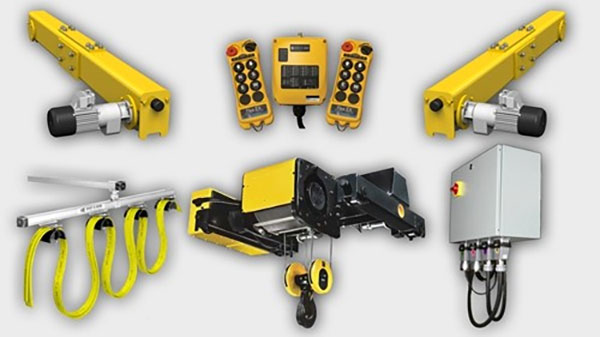
- Electric hoist: The electric hoist is the core component of the lifting system and is mainly used to lift and lower heavy objects. It usually includes motors, reducers, drums, wire ropes, hooks and other parts.
- Wire rope: The wire rope is wound through the drum to achieve the lifting or lowering of heavy objects. The quality and specifications of the wire rope must meet the requirements of the lifting capacity and have high strength and wear resistance.
- Hook: The hook is used to grab and fix heavy objects. It is usually made of high-strength alloy steel and has an anti-unhooking device to ensure that the heavy objects will not fall off accidentally during the lifting process.
- Guide wheels and pulleys: These components are used to guide and support the wire rope, reduce friction and wear, and improve lifting efficiency and system life.

3. End Carriages
The end beam usually consists of the following parts:
- Beam body: The main structure of the end beam, usually a rectangular steel tube or a box structure, to ensure that it has sufficient strength and rigidity.
- Wheel set: Running wheels are installed at both ends of the end beam, and the wheel set usually consists of a driving wheel and a driven wheel. The wheel is fixed to the end beam through a connecting shaft to achieve the lateral movement of the end beam along the track.
- Drive device: In some configurations, the end beam is also equipped with a motor drive device, which is driven by a reducer so that the wheel set drives the entire crane to run on the track.
The end beam is usually made of high-strength carbon steel or low-alloy structural steel to ensure that it will not deform when bearing the weight of the main beam and the operating load. The selection of materials also needs to consider the requirements of the use environment, such as anti-corrosion, anti-rust and other characteristics.

4. Crane traveling mechanism
The crane running mechanism of a single-beam bridge crane is a key component for the lateral movement of the crane, responsible for driving the entire crane to move along the track in the factory or in the open field. The design, structure and performance of the crane running mechanism directly affect the operating efficiency, stability and safety of the crane. The crane running mechanism usually consists of the following main components:
- Wheel set: The core component of the crane running mechanism, usually including the driving wheel and the driven wheel. The wheel set is installed under the end beam through the bearing and directly contacts the track.
- Drive device: It consists of an electric motor, a reducer, a brake, etc., responsible for driving the wheel set to move. The drive device is usually installed on the end beam on one side and connected to the wheel set through a connecting shaft.
- Track: The rails or I-beams laid on the crane’s travel path provide a path for the trolley to run. The flatness and strength of the track are crucial to the smoothness of the trolley’s operation.
5. Trolley traversing mechanism
The trolley running mechanism is mainly composed of the following parts:
- Trolley frame: The structural frame of the trolley is usually welded from steel and has sufficient strength and rigidity to carry the lifting device and operating load.
- Wheel set: A wheel set is installed under the trolley frame, usually including a driving wheel and a driven wheel. The wheels are connected to the trolley frame through bearings, so that the trolley can run smoothly on the main beam track.
- Drive device: The drive device of the trolley usually consists of an electric motor, a reducer and a brake, which drives the trolley to run along the track on the main beam.
- Lifting device: The trolley is usually equipped with an electric hoist or other lifting mechanism, which is responsible for lifting and lowering heavy objects.
The operation of the trolley is usually integrated with the electrical control system of the entire crane. The operator can control the start, stop, speed adjustment and position control of the trolley through the ground control button, wireless remote control or joystick in the cab. Modern trolley running mechanisms are usually equipped with variable frequency speed regulation systems, which make the start and stop of the trolley smoother and more flexible in low-speed and high-precision operations.
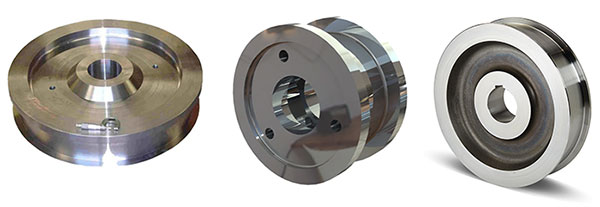
6. Crane wheel
The main functions of the wheel are:
- Support the crane: carry the entire weight of the crane and its lifting objects.
- Enable movement: through contact with the track, the crane can move horizontally (trolley operation) or longitudinally (trolley operation) along the track.
- Guide: ensure that the crane runs smoothly along the predetermined track during movement to prevent derailment.
Wheels are usually made of the following materials:
- Cast steel: Cast steel wheels have higher strength and wear resistance and are suitable for use under high load conditions.
- Forged steel: Forged steel wheels have higher strength and impact resistance than cast steel wheels and are suitable for heavy-loaded and frequently used cranes.
- Composite materials: In some special cases, wheels may be made of composite materials to reduce weight or improve specific properties (such as corrosion resistance).
7. Crane hook
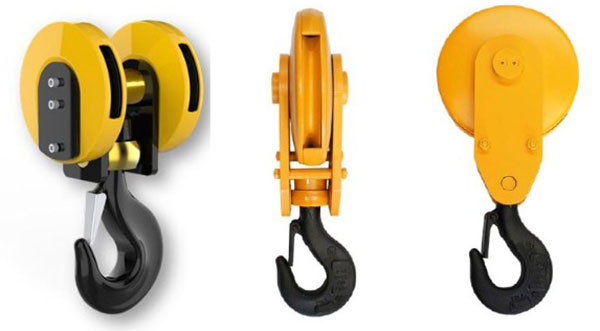
The hook can easily hang and fix various shapes of heavy objects, such as rings, steel ropes or other lifting devices, through its special shape. The hook must be able to withstand the maximum rated load of the crane and maintain stability during the lifting process. After the heavy object reaches the designated position, the hook can safely release the heavy object to ensure the smooth progress of the lifting process.
Common types of hooks include:
- Single hook: simple structure, usually used for lifting light and medium loads, suitable for single-beam bridge cranes.
- Double hook: composed of two symmetrical hooks, suitable for large or irregular heavy objects that need to be lifted in a balanced manner.
- Hook with safety device: An automatically closed safety device is equipped on the hook to prevent the heavy object from accidentally falling off. This design greatly improves the safety of operation.
The hook is usually made of high-strength alloy steel with good tensile strength and toughness: Most hooks are made of forged alloy steel, which has higher tensile strength and impact resistance, and is suitable for high-load and frequently used lifting operations. To further improve strength and wear resistance, the hook usually undergoes heat treatment processes such as quenching and tempering to enhance its mechanical properties.
8. Motor
Basic functions of motors
- Drive the lifting mechanism: The motor provides power for the lifting mechanism of the crane, so that the hook or other lifting equipment can move up and down to complete the lifting and placement of heavy objects.
- Drive the operating mechanism: The motor drives the trolley or car operating mechanism of the crane, so that the crane can move along the track to achieve horizontal movement of heavy objects.
Types of motors
In single-beam bridge cranes, the commonly used motor types include:
- Three-phase asynchronous motor: This is the most common type of motor, with the characteristics of simple structure, reliable operation and convenient maintenance, suitable for most industrial cranes.
- Variable frequency motor: When used in conjunction with a frequency converter, it can achieve stepless speed regulation and soft starting of the crane, increase the smoothness of operation and the accuracy of control, and is especially suitable for occasions with high requirements for speed control.
- Servo motor: Used in applications requiring high-precision positioning, it has the characteristics of fast response and high control accuracy.

9. Sound and light alarm system & limit switch
Basic functions of the sound and light alarm system
- Warning function: When the crane fails, is overloaded, approaches a dangerous area or other abnormal conditions occur, the sound and light alarm system will emit sound and light signals to alert the operator to avoid accidents.
- Working status indication: When the crane is working normally, the sound and light alarm system can also be used to indicate the working status of the crane, such as running, stopped or faulty.
Components of the sound and light alarm system
- Sound device: usually a buzzer or alarm, which emits a high-decibel sound to attract the attention of the operator and surrounding personnel.
- Light alarm device: includes a flash light or LED light, which emits a bright light signal, usually red or yellow, to enhance the visual warning effect.
- Control module: used to control the switch of the sound and light alarm device and the triggering of the warning signal, usually integrated with the crane’s control system.
Basic functions of limit switch
- Prevent overtravel: The limit switch is used to monitor the movement range of the crane or trolley to prevent it from exceeding the set safety range and protect the equipment and operators.
- Automatic shutdown: When the running parts of the crane approach or reach the preset limit, the limit switch will automatically cut off the power supply and stop the operation of the equipment.
Working principle of limit switch
- Mechanical contact: The travel switch detects the position of the moving parts through mechanical contacts. When the part reaches the limit position, the contact closes or opens, and sends a signal to stop the operation of the equipment.
- Non-contact sensing: For example, the proximity switch can detect the position of the object without physical contact through electromagnetic induction or optical principles, and send a signal to trigger an alarm or stop the equipment.

10. Safety Devices
The safety device of a single-beam bridge crane is an important part of ensuring the safety of crane operation and improving operational stability. The following is an introduction to common safety devices and their functions:
- Overload protection device: Real-time monitoring of the hoisting load to ensure that the load does not exceed the rated load of the crane, thereby preventing the equipment from being overloaded. When an overload is detected, the overload protection device will sound an alarm and automatically stop the lifting operation.
- Electrical protection device: Protect motors, cables and other electrical components from electrical faults such as overload, short circuit and leakage. Monitor the status of the electrical system and cut off the power supply in abnormal conditions to protect the safety of equipment and personnel.
- Braking system: The braking system is used to maintain the stability of the hoisted object during lifting and lowering. In an emergency, the braking system can quickly stop the movement of the crane to protect the safety of equipment and personnel.
- Sound and light alarm system: When the equipment fails, is overloaded or approaches the limit, the sound and light alarm system will sound an alarm to remind the operator to take necessary safety measures. Indicates the working status of the crane, such as running, stopped or faulty.
- Safety cover: Cover and protect the moving parts of the crane, prevent the operator from direct contact with the moving parts, and thus reduce the possibility of accidents. Prevent dust, dirt or foreign matter from entering key components to protect the normal operation of the equipment.
- Emergency stop device: In the event of an emergency, by pressing the emergency stop button, all movements of the crane will be stopped immediately to prevent the accident from further expanding. The emergency stop device should be easy to operate and be able to cut off the power supply or brake device in the shortest time.
11. Control Mode
The control method of a single-beam bridge crane determines the convenience, control accuracy and safety of the crane. The following are common control methods and their characteristics:
- Ground control: The operator directly controls the various functions of the crane on the ground, which is convenient and intuitive to operate. Suitable for most standard crane operating environments, such as factories, workshops, etc.
- Cab control: The operator centrally controls all crane movements in the cab above the crane. Suitable for occasions that require highly centralized operation and precise control, such as large warehouses or production lines.
- Remote control: Allows the operator to control the crane away from the crane, increasing the flexibility and safety of the operation. Especially suitable for application scenarios that require operators to stay away from dangerous areas, such as crane operations in high temperatures or harmful environments.
- Automatic control: Automatically complete the operation of the crane through computer programs or control systems, reducing human intervention. Especially suitable for operations that require high precision and repeatability, such as automated production lines and warehousing systems.
- Hybrid control: Combines the advantages of ground control, cab control and remote control to achieve flexible switching of multiple control modes. Suitable for applications that require multiple control methods, such as large industrial facilities.
12. Sketch

Application of bridge girder crane
- Power and energy industry: used to move generators, transformers and other power equipment. Used to install large equipment and facilities in power plants. Used to perform equipment inspection and maintenance to ensure the normal operation of equipment.
- Transportation: used to move and load and unload goods, luggage and other items in airport cargo areas. Used to move and install track components and equipment at railway maintenance sites.
- Chemical industry: used to move and handle chemicals, raw materials and intermediate products. Used to assemble and install large reactors and equipment in chemical plants. Used to move chemicals in hazardous environments to ensure the safety of operators.
- Mining: used to move ores, mineral materials and mineral products. Used to install and maintain large equipment and machinery in mines.
- Manufacturing: used to move and load and unload raw materials, semi-finished products and finished products in workshops. For example, material handling and assembly on automated production lines. Used to move and install production equipment and machine parts, especially in smaller or medium-sized manufacturing companies. Used to accurately move and place parts in assembly lines and production processes.
- Warehousing and logistics: used for cargo loading and unloading operations in warehouses and logistics centers, especially in environments that require frequent handling. Used to move and sort inventory materials in the warehouse to improve storage efficiency. Perform material pick-up and placement operations in the high-bay racking system to ensure timely entry and exit of goods.
- Construction Industry: Used to move building materials such as bricks, steel, concrete, etc. on construction sites. Used to install large building components such as precast concrete panels and steel structure components. Used to install heavy construction equipment and machinery to designated locations.
Advantages of bridge girder crane
Flexible operation: It can realize efficient lifting and horizontal movement operations, and is suitable for fast cargo loading and unloading and handling tasks. It supports multiple control methods, including ground control, cab control, remote control, etc., to adapt to different operation requirements.
Wide applicability: It is suitable for material handling needs in various industries, including manufacturing, warehousing, logistics and construction. It can handle loads of different weights and types, and there are applicable equipment models from light to medium loads.
High safety: The structural design of the single-beam bridge crane ensures its stability during operation and reduces the risk of accidents caused by improper operation. It is usually equipped with a variety of safety devices such as limit switches, overload protection, and sound and light alarm systems to ensure safe operation.
Easy to install and debug: Due to its simple structure, the installation process of the single-beam bridge crane is relatively fast and simple, which reduces the construction period. Problem handling during debugging is also relatively easy, and it can quickly adapt to the needs of the actual working environment.
High operating accuracy: Due to the smooth operation of the single-beam bridge crane, it can achieve precise lifting and moving operations, which improves the working accuracy. Equipped with modern control systems, it can achieve more precise operation and adjustment.
Energy saving and environmental protection: Modern single-girder bridge cranes usually use high-efficiency motors and intelligent control systems, with high energy efficiency ratios and reduced energy consumption. The noise during operation is low, reducing noise pollution to the working environment.
Customized selection: Single-girder bridge cranes can be customized and configured according to specific needs to meet different operating requirements and working environments

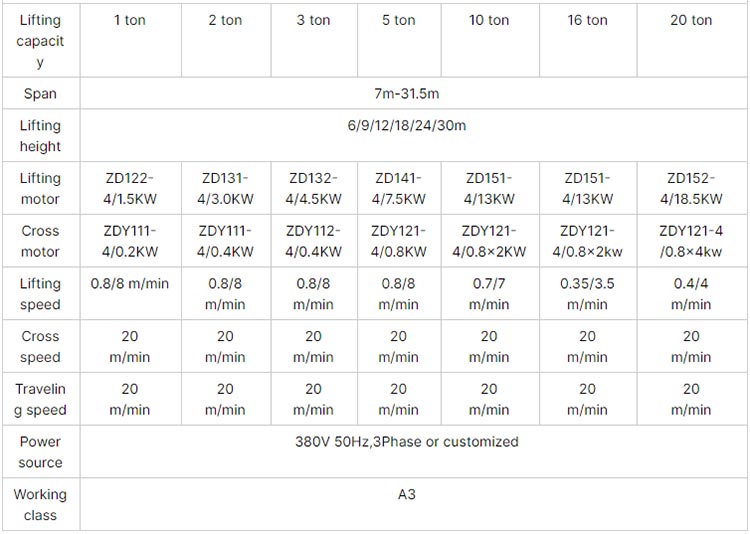
Main technical data
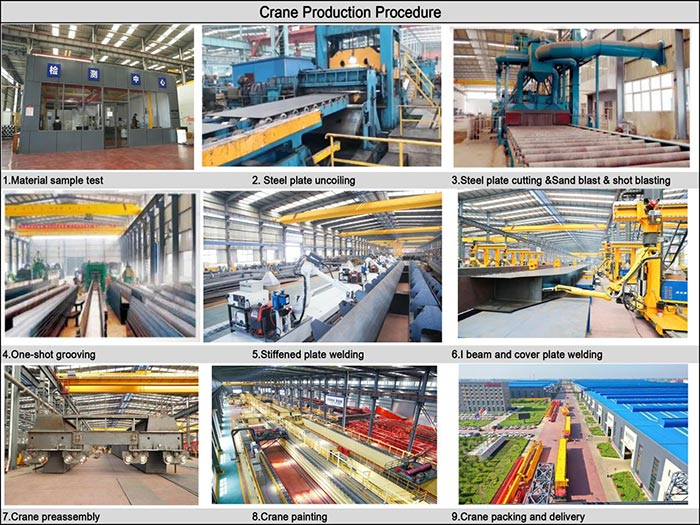
Crane production procedure
1. Demand Analysis and Design: Communicate with customers to understand their operating environment, load requirements, working frequency and other requirements. According to the requirements, design the overall plan of the crane, including the main beam, end beam, trolley, lifting system and other major components. Carry out detailed structural design to ensure structural strength and stability.
2. Material procurement: Purchase steel, aluminum alloy, transmission components, electrical components, etc. required for manufacturing cranes. According to design requirements, purchase standardized components such as motors, reducers, brakes, etc. Carry out quality inspection on purchased materials and components to ensure compliance with standards and design requirements.
3. Manufacturing and processing: Cut, weld and process steel to manufacture main beams and end beams. Manufacture components such as the frame, guide wheels, lifting devices of the trolley. Produce or assemble various components of the electrical control system, including contactors, relays, sensors, etc. Weld steel structure components to ensure connection strength and stability. Perform mechanical processing on components, such as drilling, milling and turning, to ensure the size and accuracy of components. Paint or coat components to protect steel from corrosion and wear.
4. Assembly: Assemble the main beam, end beam, trolley, lifting system and other components according to the design drawings. Connect the electrical control system to the mechanical components, including cable routing, wiring and debugging. Perform preliminary system debugging, check the coordination and function of each component, and ensure the normal operation of the system.
5. Testing: Perform static load test to check the load-bearing capacity and stability of the crane under static conditions. Perform dynamic operation test to check the performance of the crane in actual operation, including lifting, lowering, running speed, etc. Test the functions of various safety devices, such as limit switches, overload protection, sound and light alarm systems, etc.
6. Inspection and acceptance: Conduct a comprehensive inspection of the manufacturing and assembly quality of the crane to ensure compliance with design standards and technical requirements. Perform functional acceptance with the customer to confirm that the performance and functions of the crane meet the customer’s needs.
Global Market

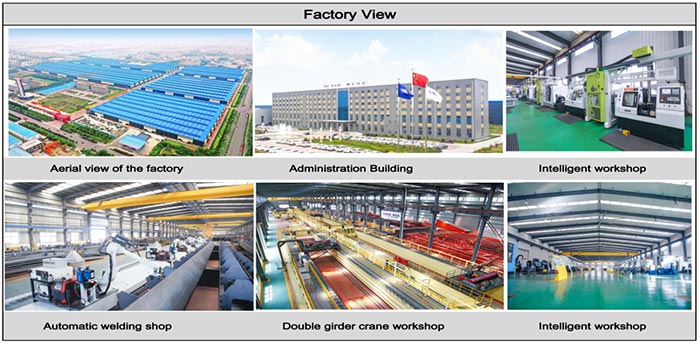
Workshop view
The company has installed an intelligent equipment management platform, and has installed 310 sets (sets) of handling and welding robots. After the completion of the plan, there will be more than 500 sets (sets), and the equipment networking rate will reach 95%. 32 welding lines have been put into use, 50 are planned to be installed, and the automation rate of the entire product line has reached.