

Description
Warning: mysqli_query(): (HY000/1194): Table 'wp_options' is marked as crashed and should be repaired in /www/wwwroot/excelcrane.com/wp-includes/class-wpdb.php on line 2349
Warning: mysqli_query(): (HY000/1194): Table 'wp_options' is marked as crashed and should be repaired in /www/wwwroot/excelcrane.com/wp-includes/class-wpdb.php on line 2349
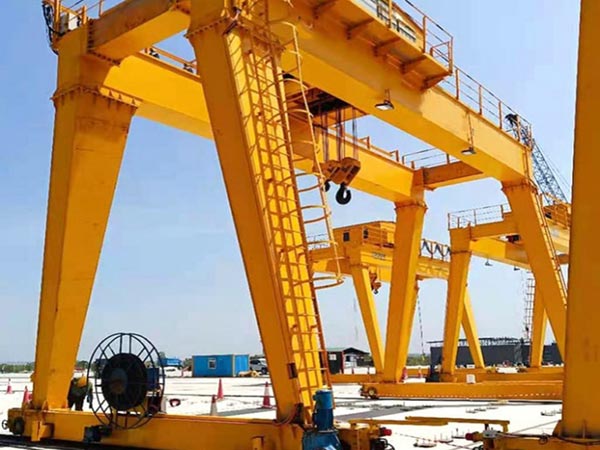
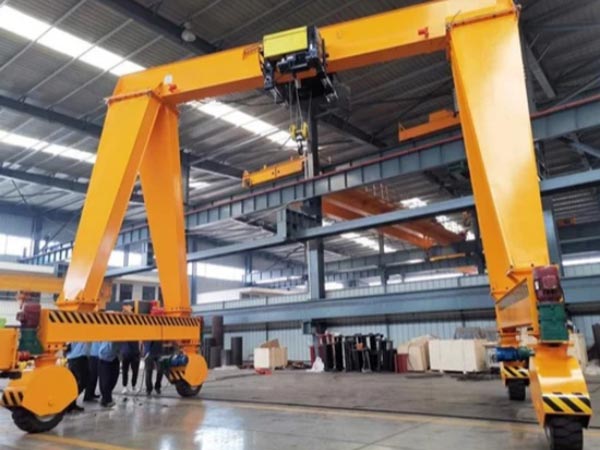
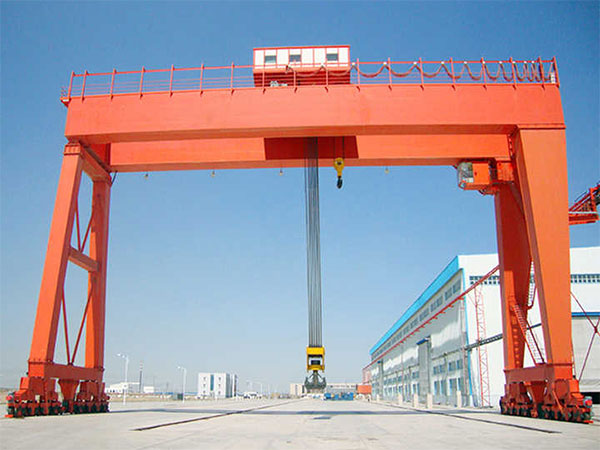
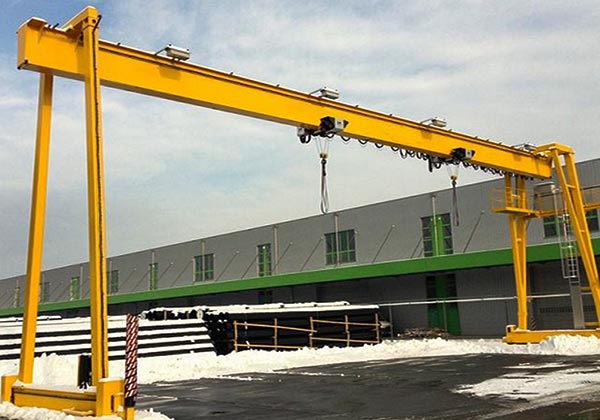
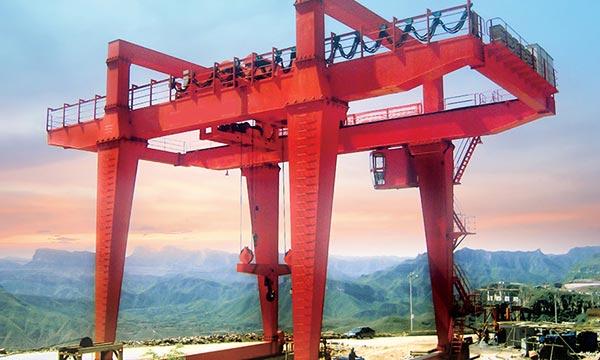
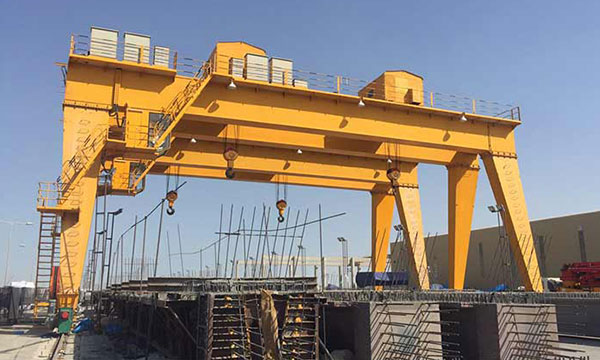
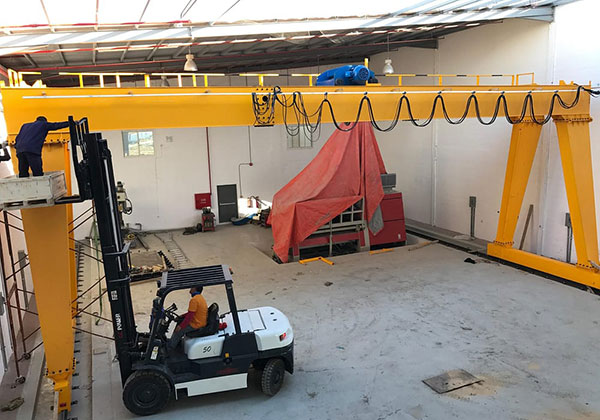
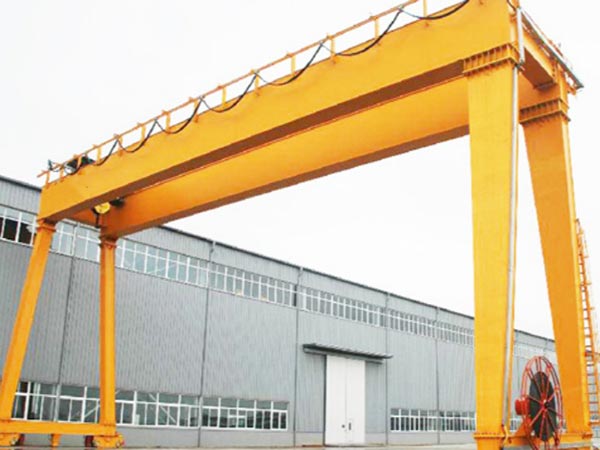
The double-girder gantry crane is an important lifting equipment and is widely used in factories, docks, cargo yards and other places for heavy object handling and loading and unloading operations. The double-girder gantry crane adopts a double-girder structure design and has high strength and rigidity, which allows it to carry a large lifting capacity. Compared with single-girder cranes, the double-girder structure provides better stability and balance, and is suitable for various complex operating environments, such as high temperature, humidity, and open air. Double-girder gantry crane has become an indispensable lifting equipment in various industrial fields with its unique structural design, excellent performance advantages and wide range of application scenarios. Through reasonable operation and regular maintenance, this crane will provide users with efficient, safe and stable lifting solutions.
Components of gantry girder crane
1. Mast: The gantry is the skeleton of a double-girder gantry crane and consists of a main beam and outriggers. The main beam usually adopts a box-shaped or truss structure, which has high strength and rigidity and can carry a large lifting weight. The outriggers are supported on ground rails to ensure the stable operation of the crane.

2. Crane operating mechanism: The crane operating mechanism is responsible for the movement of the crane along the track. It is mainly composed of motors, brakes, reducers, couplings, transmission shafts, wheels and other components. This mechanism provides the power for longitudinal movement of the crane and ensures smooth and precise movement.

3. Trolley: The trolley is located on the bridge guide rail and can move along the width of the workshop. It is mainly composed of a steel plate welded trolley frame and the trolley running mechanism and lifting mechanism on it. The motor drives the trolley driving wheel through the reducer and drags the trolley to move along the guide rail.

4. Hoist: In double girder gantry cranes, the hoist is usually in electric form, i.e. electric hoist. Electric hoists are driven by electric motors and lift goods through wire ropes or chains. The core component of the electric hoist is the motor, which drives the transmission system to rotate the drum to lift or lower the goods. The drum is used to wrap the wire rope or chain and control the lifting and lowering of the goods through its rotation. To prevent possible dangers during operation, electric hoists are equipped with limit switches and a variety of safety devices, such as overload protection and anti-fall devices.

5. Sketch:

Application of gantry girder crane
1. Construction: On construction sites, double-girder gantry cranes are used to lift and move construction materials such as concrete, steel bars, and prefabricated elements. Its high efficiency and stability greatly improve the construction efficiency and shorten the construction period.
2. Steel industry: In steel companies, double-girder gantry cranes are widely used in material handling between raw material warehouses, finished product warehouses and production lines to ensure the continuity and safety of production.
3. Aviation and shipbuilding: In these industries, double-girder gantry cranes are not only used for the assembly of large components, but also participate in material handling and equipment maintenance throughout the production process, providing strong support.
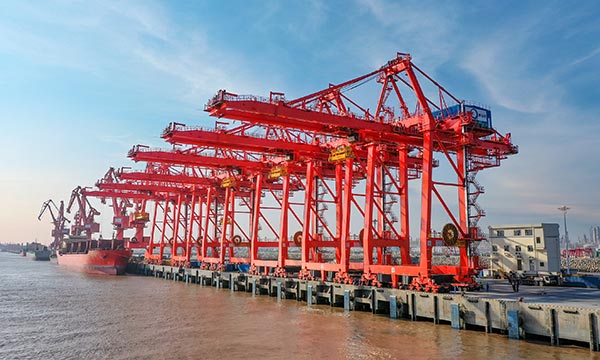
4. Terminals and cargo yards: Double-girder gantry cranes play a key role in docks and cargo yards and are mainly used for loading, unloading, stacking and transshipment of goods. Its efficient lifting capacity greatly improves cargo handling efficiency and reduces ship docking time.

Advantages of gantry girder crane
Stability and reliability: Double-girder gantry cranes adopt a double-girder structure. This design provides greater stability and balance, ensuring good mechanical stability when lifting and moving heavy objects. Compared with single-girder cranes, the double-girder structure can withstand larger lifting loads while reducing structural stress and wear caused by uneven loads.
Efficient lifting capacity: Double-girder gantry cranes are designed with optimized lifting mechanisms and are usually equipped with electric hoists. These hoists are characterized by high efficiency and quick response. This means that when performing lifting tasks, the crane can quickly raise or lower the load and position it accurately, thereby improving overall work efficiency.
Flexibility and adaptability: Double-girder gantry cranes can be customized according to different industrial applications, such as track span, lifting height and load capacity can be adjusted according to actual needs. This ability to customize allows it to adapt to a variety of work environments, such as factory floors, warehouses, docks and even outdoor job sites.
Environmental protection and energy saving: The new double-girder gantry crane pays more attention to environmental protection and energy saving when designing, using high-efficiency motors and energy recovery systems to reduce energy consumption and operating costs. These environmentally friendly designs not only reduce the company’s operating expenses, but also meet the requirements of modern industrial production for sustainable development.

Main technical data

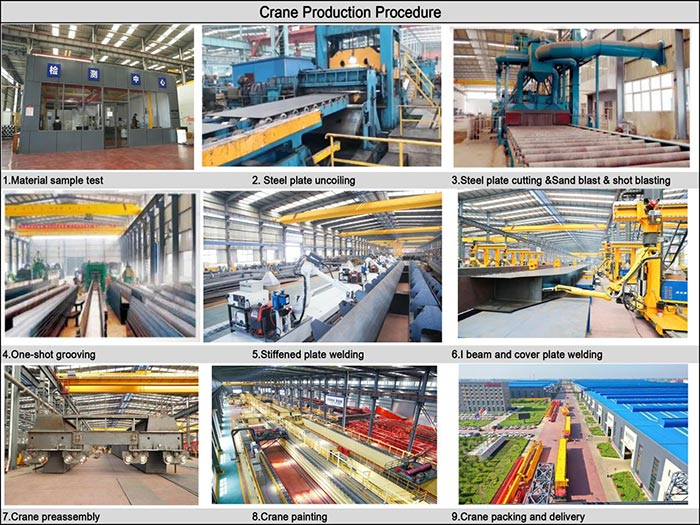
Crane production procedure
1. Demand Analysis and Design: Communicate with customers to understand their operating environment, load requirements, working frequency and other requirements. According to the requirements, design the overall plan of the crane, including the main beam, end beam, trolley, lifting system and other major components. Carry out detailed structural design to ensure structural strength and stability.
2. Material procurement: Purchase steel, aluminum alloy, transmission components, electrical components, etc. required for manufacturing cranes. According to design requirements, purchase standardized components such as motors, reducers, brakes, etc. Carry out quality inspection on purchased materials and components to ensure compliance with standards and design requirements.
3. Manufacturing and processing: Cut, weld and process steel to manufacture main beams and end beams. Manufacture components such as the frame, guide wheels, lifting devices of the trolley. Produce or assemble various components of the electrical control system, including contactors, relays, sensors, etc. Weld steel structure components to ensure connection strength and stability. Perform mechanical processing on components, such as drilling, milling and turning, to ensure the size and accuracy of components. Paint or coat components to protect steel from corrosion and wear.
4. Assembly: Assemble the main beam, end beam, trolley, lifting system and other components according to the design drawings. Connect the electrical control system to the mechanical components, including cable routing, wiring and debugging. Perform preliminary system debugging, check the coordination and function of each component, and ensure the normal operation of the system.
5. Testing: Perform static load test to check the load-bearing capacity and stability of the crane under static conditions. Perform dynamic operation test to check the performance of the crane in actual operation, including lifting, lowering, running speed, etc. Test the functions of various safety devices, such as limit switches, overload protection, sound and light alarm systems, etc.
6. Inspection and acceptance: Conduct a comprehensive inspection of the manufacturing and assembly quality of the crane to ensure compliance with design standards and technical requirements. Perform functional acceptance with the customer to confirm that the performance and functions of the crane meet the customer’s needs.
Global Market

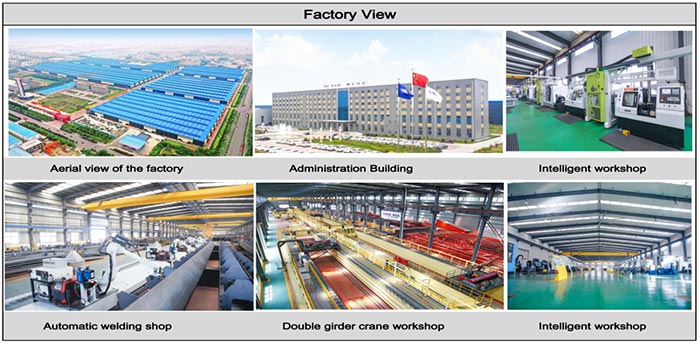
Workshop view
The company has installed an intelligent equipment management platform, and has installed 310 sets (sets) of handling and welding robots. After the completion of the plan, there will be more than 500 sets (sets), and the equipment networking rate will reach 95%. 32 welding lines have been put into use, 50 are planned to be installed, and the automation rate of the entire product line has reached.